Effective Concepts LLC.
is a small company out of Fargo, ND. We specialize in selling lamps, ballasts, and energy services to customers in the Fargo-Moorhead area. We sell wholesale, meaning an on-going relationship with commercial customers that are willing to trade a little lead time for better pricing. We are authorized distributors of Sylvania, Havells, and TCP lamps and ballasts.I have over thirty-five years of wholesale experience and a Marketing degree from Minnesota State University Moorhead. I have over 40 years experience with computers, everything from programing, database design, spreadsheet modeling, to graphic design. I am also the webmaster for a number of web sites. I help out small company sites but have also done some large e-commerce sites and one page sites for nonprofit organizations. You don’t have to pay a lot of money to have a nice website or blog. – Craig Maas
About
Craig Maas has twenty-five years of wholesale experience. Craig has a Marketing degree from Moorhead State University and is responsible for developing one of the most advanced computerized marketing systems in the country.
Craig Maas is the webmaster for a number of web sites. We specialize in small company sites and simple sites for nonprofit organizations. “You don’t have to pay a lot of money to have a nice site.” We also provide assistance to set up and maintain blogs, wiki’s and other web tools. “I like working with customers who believe content is king. My best customers are those I learn as much from as they do me.”
Effective Concepts LLC is company that was formed in 1991 by Ray and Craig Maas. Effective Concepts is a authorized distributor of Sylvania Lighting Products. Ray has over 40 in the Distribution Industry, while Craig has over twenty-five years of wholesale experience. Ray has an Engineering degree and Craig has a Marketing degree. The company’s primary focus is Lighting and Energy Savings but we also spend a lot of time marketing. Craig also has experience writing custom database packages, spreadsheets, and graphic design (both freehand and computer).
Ray Maas had almost fifty years experience running and managing wholesale distribution companies. Ray had an Engineering degree from North Dakota State University. Ray had experience with Lighting, Controls, Pump Systems, Heating and Air Conditioning.
Past Services
Do you need our services?– Is your annual operations budget in need of a trim. In most cases the answer is yes. Not only can you reduce your operations budget but a properly designed energy retrofit can return money to your pocket. Annual return on investments (ROI) between 20% and 50% are NOT unusual. Maintenance costs can also drop when you upgrade your lighting or HVAC equipment. If designed properly your facilities will show in increase in employee productivity. Performance and safety can be enhanced with new efficient lighting design. The more extensive a facilities needs the more extensive the savings. Our approach is to help you maximize these savings.
Design
The efficient use of energy requires proper design. This is true for lighting and heating. Effective Concepts has years of experience in both fields. We use our expertise to design optimal lighting or heating systems. Whether you are looking for new equipment or wish to retrofit your current lighting fixtures, we can help you. We can design around your design requirements. These include: Cost savings, energy savings, pollution savings, or lighting design changes.
Audits
Proper designs starts with detailed and accurate information. We will provided a free audit of your site. We look at various factors depending on the type of design you are looking for: Counts of existing fixtures, type, and their location. We may also take light level readings if needed.
Lighting Is An Investment
Now is the time to look at your facility for savings. The energy you use to light your facility is going to waste. Your old four lamp fixture uses 188 watts per hour. At 6¢ per kWh, that is only a penny per hour, but over the life of the lamp you’re burning up $135.
Effective Concepts can provide you with an alternative one which can result in a short payback on your investment. The money you are sending to the utility is giving you no payback. Many utilities will actually help you with your lighting retrofit by providing a rebate.
With all the pressure to reduce costs and minimize expenses, why not invite Effective Concepts to have a look at your facility. We may have the solution to your budget problems.
Output
- Lighting Audit, showing existing fixtures, replacement fixtures, locations
and savings. - Pollution Savings a sample graph showing
savings of natural resources conserved. - Cost Savings, Cash Flow, and Return on Investment
- Lighting Conservation/ Light Levels a sample
store showing before and after lighting retrofits (60K graphic) - Grant Forms to help qualify you for loans or grants.
- Rebate Forms to help qualify you utility rebates
- Heatloss & Layouts
Customers
- Grocery Stores
- Retail Stores
- Educational Facilities
- Government Facilities
- Health Care Facilities
- Wholesalers
- Manufactures
Contact Me:

Effective Concepts LLC.
1732 23rd Street South
Fargo, ND 58103
(701) 235-2035
Mytech Motion Detectors
Updated 5/24/2012
Call or email Craig Maas to order or for more information.
Quantities limited to on hand: first come first serve.
Freight and terms apply.
Hubbell bought out Mytech and the model numbers have changed.
Billing:
Call or email with your request. We will confirm our stock. If it meets your approval we will email a Paypal generated invoice, which you can pay with your credit card. We ship upon payment confirmation from Paypal.
We can also accept Purchase Orders from Schools, Institutions, or commercial firms. Call first for approval.
| Qty | Mytech | Hubble | Descriptions | Grainger | Our Price |
|---|---|---|---|---|---|
| 1 | DT2000 | ATD2000C | Ultrasonic & Infrared Occupancy Sensor, 2000 sq.ft. coverage 24 volt |
241.75 | 115.00 |
| 4 | US2000 | ATU2000C | Ultrasonic Occupancy Sensor, 2000 sq.ft. coverage 24 volt |
226.75 | 105.63 |
| 1 | US1000 | ATU1000C | Ultrasonic Occupancy Sensor,1000 sq.ft. coverage 24 volt | 199.25 | 88.00 |
| 2 | US500 | ATU500C | Ultrasonic Occupancy Sensor,500 sq.ft. coverage 24 volt | 164.50 | 48.75 |
| 16 | MP120 | CU300A | Power Pack 120 volt for US and DT Sensors, 20 amp | 59.20 | 24.95 |
| 0 | MP277 | CU300A | Power Pack 277 volt for US and DT Sensors, 20 amp | 59.20 | 24.95 |
- These are new Mytech units still in the box.
- I may be able to get more Power Packs from another source but the price may be more.
- Powers Packs can be used as Slave Relays
- Grainger.com prices as of 2012
Spec Sheets
Mytech cut sheets: Omni-DT Sensors
and MP Series Power Packs.
More Info about Omni Sensors: Adaptive Functions, Features, Controls, Ranges, Automatic Timer & Automatic Sensitivity, Indicator, Automatic Status Reporting, Physical Wiring, Options/Accessories, and Specifications.
General Operation
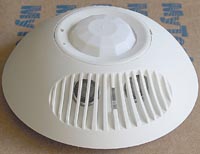
Occupancy sensors have two tasks: keeping the lights on while the room is occupied and, conversely keeping the lights off when unoccupied.
Ultrasonic (doppler shift) motion detection gives maximum sensitivity yet can be vulnerable to false triggering from air conditioning currents, corridor activity and movement of inanimate objects. infrared motion detection gives immunity to false triggering, but lacks sensitivity at greater distances.
- Upon room entry sensor is in “high confidence” (miser) mode.
Infrared/ultrasonic composite must be above a specific threshold to turn lights
on. - Once occupied, sensor enters “high sensitivity mode” the threshold
automatically lowers and the slightest movement will keep the lights
on. - When unoccupied, lights stay off while air conditioning system cycles
on and off, and cleaning crews occupy corridors.
Composite Dual Tech Sensing
Using infrared sensing (high error immunity) with ultrasonic (high sensitivity) provides good performance. Conventional dual tech sensors use a simple formula for operation: BOTH for ON, EITHER for KEEP ON. This method requires that both sensors receive fixed-strength signals for ON or a single fixed level signal for KEEP ON.
The OMNI uses a more sophisticated method called a composite signal where the signal strengths are added together to form a composite sum. The advantage of this method is that a week IR signal plus a strong US signal will turn the lights on because the sum is enough. The installer need not worry that the signal level be balanced for reliable lights on.
Mytech is now the ‘Wiring Devices-Kellems’ division of Hubbell.
The sensors are known as Hubbell Motion Sensor Switches or HMOSS
(See Section D of Hubbell’s current catalog.)
Magazines Links
Magazine Notes
- ASHRAE Journal – you can buy reprints by searching article titles or browse the articles by issue.
- Sustainable Facility previously known as Energy User News. Old archives Before Sept 2007 and New Archives
- Engineered Systems with archives back to June of 1999. You have to register but it’s free and not difficult. They also have a Blog but it doesn’t seem to be up active.
- Heating Piping & Air Conditioning– HPAC nice archive all the away back to January 1992.
- Archietectural Lighting Online– devoted to lighting mostly high end fancy lighting with great photography in the issues. Archives go back to November 2006. It appears you can search for older articles.
Weather Report
A monthly Engineered Systems column that has some great information about using weather data to estimate loads and savings. Unfortunately it doesn’t appear archived- at least I can’t find it. By Michael Kjelgaard, P.E. Engineering Weather Data
- Heat Recovery Systems. March 2004
- Pushing Economizer Cooling To The Limit. July 2004
- Sensible Loads. August 2004
- Ventilation Load Analyzer. September 2004
- Economizer Savings. November 2004
- Economizer Savings II. December 2004
- Bin Data. April 2005
HVAC Commercial
Estimating Demand & Efficiency
Score Sheet for HVAC System Efficiency: Nice spreadsheet for estimating overall efficiency of a commercial HVAC system. It covers 7 system elements: Chiller/Compressor, Supply Air Handling Unit, Return Fan Pressure, Chilled Water Pump Head, Condenser Pump Head, Cooling Tower or Condenser Fan, Zone or VAV Terminal Fans.
The program/ spreadsheet is available at www.geokiss.com (not online anymore? Try Google and Archive.org. ) Ground Source Heat Pump Design: Keep It Simple & Solid
ASHRAE Journal, July 2003, p36
A New Way To Calculate Cooling Loads
Overview of ASHRAE’s new Radiant Time Series (RTS) method of calculating commercial loads.
ASHRAE Journal, January 2004, p20
Universal Translator
The Universal Translator is a tool that allows filtering, analysis and visualization of large Energy Management and Control Systems (EMCS)data sets. The program can be found at www.utonline.org.
ASHRAE Journal, July 2007, p12
Going Swimmingly
This one is odd. An indoor swimming pool in Alaska. I found it interesting anyway.
Engineered Systems. May 2006
The Terrible Too’s
Avoid ventilation mistakes of environmental complaints, too: warm, cool, drafty, stuffy, noisy, quiet, expensive, and complicated.
Engineered Systems. April 2007
Ventilation
Ventilation Design And Performance In US Office Buildings
A EPA survey of 100 buildings- it’s rather abstract
ASHRAE Journal, April 2005
Beyond The Affinity Laws
Article to make sure you avoid overestimating or under performing VSD applications. It’s also a good overview on electric motors.
Engineered Systems. August 2004
Fan Energy System Optimization
From motor load to duct fitting- get the most out of your fan system. Efficiency, software, power vs performance. On a new or retro fit.
Engineered Systems. May 2006
Energy Efficient Motors & Drives
Calculating savings and costs for motors and drives.
ASHRAE Journal, January 2004, p30
Technology Positioned to help with Industry Challenges
Overview of Energy Recovery Ventilation (ETV) technologies.- light overview so I threw it out. The online magazine has no archives and is only published once a year.
ARI Magazine, Spring 2004, p24
Humidification Online
Online resources for sizing Humidification equipment.
Engineered Systems. April 2006
Manufacturing The Right Moisture
Explores load-related questions and other design pitfall for your humidifier.
Engineered Systems. April 2007
Lighting
Spreadsheets that Speed Lighting Calculation
Some simple spreadsheets and a program called Calculite
Simply Indoor. has some photometric layout design programs.
Energy User News, June 2005
The Virtual Thing: Lighting Software Option
Overview of a couple lighting packages but not a lot of detail.
Architectural Lighting, June 2004
- AGI32
- Lumen Designer
- DIALux– European
- Radiance lighting simulation tool appears to be open source
Daylighting Design Update: One Year Later
Overview of a couple lighting packages to deal with daylighting.
Architectural Lighting, May 2005– no photos.SPOT The Sensor Placement and Orientation Tool
Finance
Green And Purple Money
This is a letter to the editor, which in a simple way explains why energy conservation is so hard to sell. It’s one of my all time favorite clippings. It generated a lot response.
Energy User News, April 2003
Moving Beyond Simple Payback- Addressing Clients’ Financial Needs
This article highlights case studies for projects that proceeded when factors beyond energy efficiency were introduced into life-cycle analysis.
ASHRAE Journal, June 2005, p14
Found Money: A CFO’s Guide to the ROI of Lighting.
Nice overview of CFO’s who are learning they need to take a role in Lighting and Energy. ROI and due diligence.
Energy User News, July 2005
Simulating Reality On Your PC
Energy Auditing using computer software.
Engineered Systems. March 2005
Commissioning: Tools of the Trade
Tools and software necessary to complete a commissioning or recommissioning.
HPAC Engineering, June 2004, p20 – not in archive.
Energy Software Tools
A list of 10 software packages uses to calculate energy savings. Also a side bar featuring some free software.
Energy User News, July 2003
Using Standard 90.1
Overview of the new ASHRAE Standard.
HPAC Engineering,February 2005, p35
It is vital that someone with a vested interest in utility savings is involved in a MBWA (management by wandering around) program." – ASHRAE Journal, June 2005, p74
Archive
Links to products we sold, old services, and a guide to Romance, that my father wrote in his spare time!